Showing posts with label Inverter circuit. Show all posts

SpeedWatt 300W Car Inverter – 110V Power Inverter with Dual USB


The SpeedWatt 300W Car Inverter is a versatile and compact tool ideal for charging various electronic devices on the go. Perfect for travelers, campers, and road-trippers, this inverter offers convenient power for your electronic needs. If you’re searching for an affordable, portable car inverter, the SpeedWatt 300W model is an excellent choice.

Power and Compatibility

The SpeedWatt inverter draws power from two main sources: your car battery or a cigarette lighter outlet, utilizing 12V DC input from either source and converting it into 110V AC power. This converted AC power is then used to charge multiple devices, including phones, laptops, and other electronics, making it suitable for both travel and daily use in homes or offices.

Lightweight and Travel-Ready

Weighing in at just 1.3 lbs, the SpeedWatt inverter is lightweight and highly portable, making it easy to bring along on any trip. Its compact design enhances its portability, ensuring it fits seamlessly into travel bags or car storage compartments without taking up much space.

Durability and Protection

Built to last, this inverter features a robust aluminum housing that protects it from external wear and tear. To further safeguard the internal components, it comes equipped with multiple protective features. An integrated 40A fuse prevents voltage surges, while a quiet cooling fan maintains optimal temperature, preventing overheating.


Why Choose SpeedWatt?

If you’re a frequent traveler or in need of a reliable power source, the SpeedWatt 300W Car Inverter is a top choice. Leveraging advanced technology, this inverter provides dependable performance for charging and powering your essential devices whenever and wherever you need.

Features & Specifications

  • 40A Fuse: Built-in protection against voltage fluctuations
  • Cooling Fan: Operates quietly for a seamless experience
  • Max Temperature: Operates up to 140°F
  • Weight: Lightweight at 1.3 lbs
  • Input Power: 12V DC
  • Output Power: 110V AC, 300W continuous power, with 480W peak power
  • Multiple Ports: Includes USB and AC outlets for versatile charging options
  • Compact Design: Space-saving and easy to transport

With these features, the SpeedWatt 300W inverter is an efficient, portable, and affordable solution for powering your devices on the go. The built-in fan ensures reliable cooling, and the multiple charging options make it convenient for any situation.

A Travel Essential

According to customer reviews, the SpeedWatt inverter is a reliable and quiet performer. One user mentioned how this 300W inverter became a valuable tool for remote work during COVID-19, allowing him to charge multiple devices simultaneously, including his laptop, GoPro, and mobile devices. Unlike his previous 150W inverter, which was noisy, the SpeedWatt provides a much quieter experience without compromising on performance.

Pros

  • Versatile, multi-purpose inverter
  • Dual input power sources
  • Compact and space-saving design
  • Durable aluminum casing
  • Lightweight and portable
  • Easy to use with dual USB and AC ports
  • Ideal for travel, road trips, and camping
  • Budget-friendly

Cons

  • Short DC adapter cable

With a lengthy list of advantages, the SpeedWatt 300W Car Inverter stands out as a capable and attractive option for those needing reliable power on the go.

Conclusion

In conclusion, the SpeedWatt 300W Car Inverter is a high-performance, affordable option for those needing a dependable power source for camping, travel, or home use. Its compact design, ease of use, and multiple ports make it ideal for charging laptops, phones, and various other gadgets, proving to be an essential addition to any road trip or outdoor adventure.
Source: https://inverterreview.com/speedwatt-300w-car-inverter/

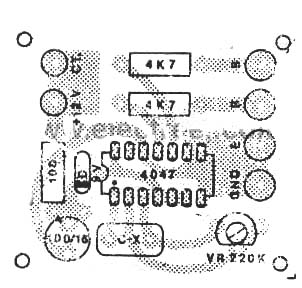
Inverter 500-W 12volt to 220volt By 2N3055 +4047 Citcuit schematic with explanation

Using this circuit you can convert the 12V dc in to the 220V Ac. In this
circuit 4047 is use to generate the square wave of 50hz and amplify the
current and then amplify the voltage by using the step transformer.
How to calculate transformer rating

The basic formula is P=VI and between input output of the
transformer we have 
Power input = Power output
For example if we want a 220W output at 220V then we need 1A at the output.
Then at the input we must have at least 18.3V at 12V because: 12V*18.3 =
220v*1

So you have to wind the step up transformer 12v to 220v but input winding
must be capable to bear 20A.
 Inverter 500-W 12volt to 220volt By 2N3055 +4047 Citcuit schematic with explanationauthor: Ashad Mustufa
Source: electronic-lab.com

Build a 250 to 5000 watts PWM DC/AC 220V Power Inverter Circuit Schemati With explanation


Build a 250 to 5000 watts PWM DC/AC 220V Power Inverter
Build a 250 to 5000 watts PWM DC/AC 220V Power Inverter Circuit Schemati With explanation

Build a 250 to 5000 watts PWM DC/AC 220V Power Inverter Circuit Schemati With explanation

Build a 250 to 5000 watts PWM DC/AC 220V Power Inverter Circuit Schemati With explanation


Build a 250 to 5000 watts PWM DC/AC 220V Power Inverter Circuit Schemati With explanation


Build a 250 to 5000 watts PWM DC/AC 220V Power Inverter Circuit Schemati With explanation


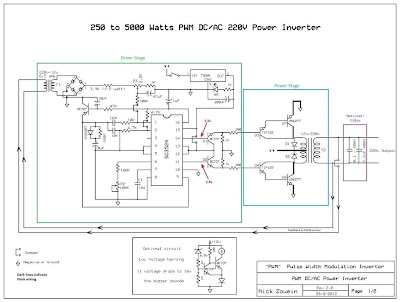
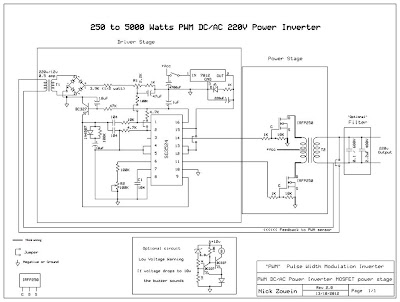
This is my schematic design of a Pulse Width Modulator DC/AC inverter using the chip SG3524 .
I have built this design and using it as a backup to power up all my house when outages occur.

If you like my work and intend to build the circuit don't forget to give me the 5 satrs :D and subscribe to me by clicking on the "follow" button so I know how many people benefit from the design, Thanks

Notes:

>The schematic circuit design is for a 250 watt output, while the pics are of my 1500 watts inverter that i built, to increase the power of the circuit you have to add more of the Q7 and Q8 transistors in parallel, each pair you add will increase your power by 250 watts, ex: to get 750 watts of power from the inverter you need to add in parallel 2 of Q7 and 2 of Q8 to the original design.

>If you increase the power transistors you have to enlarge the T2 transformer to match the new needs, the circuit's transformer is rated 25 amps to handle 250 watts of 220v, for every 1 additional amp you need on the 220v side you have to increase 10 amps on the 12v side, of course there are limits to the thickness of the winding so if you need more than 750 watts i recommend that you use a 24VDC supply instead of 12 volts:

DC voltage and Transformer "T2" winding recommendation:
Power Supply Winding
750w 12VDC P:24V "12-0-12" / S:220V
1500w 24VDC P:48V "24-0-24" / S:220V
2250w 36VDC P:72V "36-0-36" / S:220V
3000w 48VDC P:96V "48-0-48" / S:220V
3750w 60VDC P:120V "60-0-60" / S:220V
4500w 72VDC P:144V "72-0-72" / S:220V
5250w 84VDC P:168V "84-0-84" / S:220V
*The transformer should be "center tapped" at the primary side.
**You can make the secondary 110v if needed.
***The transformer in the pic is a custom made (48V center tapped / 220v ) 2000 watts, weights like 10 kilos.

>R1 is to set the PWM duty cycle to 220v. Connect voltmeter to the output of your inverter and vary VR1 till the voltage reads 220V.

>R2 is to set the frequency to 50 or 60 Hz (R2 range is between 40Hz to 75Hz), so guys that do not have a frequency meter are advised to blindly put this variable resistor mid-way which should drop you in the range of 50~60 Hz.
If you want you can substitue the variable resistor with a fixed resistor using the following formula: F = 1.3 / (RxC)
in our case to get a 50Hz output we remove both the 100K and the variable 100K both from pin 6 and we put instead a 260K fixed resistor and we leave the 0.1uF (the 104 cap) as it is, this change should give out a fixed 50Hz as per the formula :
1.3 / (260,000 ohm x 0.0000001 farad) = 50Hz
But in reality it will not exactly give 50Hz because the 260K resistor has a specific error value margin so does the capacitor, that's why i recommend a variable resistor so that accurate calibration can be achieved.

>Use either tantalum or polyester film "as in pic" for the 104 caps, ceramic disc caps change value once hot and this in turn changes the frequency of the inverter so they are not recommended.

>Pin 10 of the SG3524 can be used to auto shut down the inverter, once a positive voltage is given instead of negative to pin10, the SG3524 will stop oscillating. This is useful for persons wanting to add some cosmetic makeup to their inverters like overload cutoff, low battery cutoff or overheating cutoff.

>Wiring connections on the power stage side should be thick enough to handle the huge amps drain from the batteries. I marked them with dark black on the schema also I included a pic so you see how thick those wires must be.

>The design does not include a battery charger since each person will be building a custom version of the inverter with specific power needs. If you are ordering a custom made transformer you can ask them to take out for you an additional output wire on the primary side to give 14v (between point 0 and this new wire) and use it to charge a 12v battery, of course this needs a seperate circuit to control charging auto cut-off. But anyway this is not advisable because it will shorten the life of the transformer itself since using it as a charger will toast the enamel coating layer of the copper wires over time. Anyway .. YES can be done to reduce cost.

>A cooling fan will be needed to reduce heat off the heat sinks and transformer, i recommend getting a 220v fan and connecting it to the output T2 transformer, when you power up the circuit the fan will start this will always give you a simple way to know that 220v is present and everything is OK.. You can use a computer's old power supply fan if you like.
Note that the fan must suck air out from the inverter case and NOT blow inside, so install it the correct way or it will be useless.
Also note how I fixed both the heat sinks and where the fan is, in a way that the fan sucks hot air from like a channel between the 2 heatsinks.

>2 circuit breakers are recommended instead of fuses, one on the DC side and one on the AC side, depending on your design
Ex: for a 24vDC ( 1500 watts design ) put a 60Amp breaker on the DC side and a 6Amp on the AC side.
For every 1amp of 220vAC you will be draining like 8 to 10 Amps from the 12v battery, make your calculations !

> The 2 Heat sinks should be big enough to cool the transistors, they are separate and should NOT touch each other. "see the pics"

>Important: If you're building a big design that uses more than 24VDC as power source, make sure not to supply the driver circuit with more than 24v maximum. (EX: If you have 4 batteries 4x12 = 48v , connect the v+ supply of the driver circuit to the second battery's (+) terminal with a thin 1 mm wire which is more than enough. this supplies the driver circuit with +24v while supplies the power transformer with +48v)

> "Optional" : Deep Cycle batteries are your best choice, consider them for best results .. read more

> Be cautious when building this circuit it involves high voltage which is lethal, any part you touch when the circuit is ON could give you a nasty painful jolt, specially the heat-sinks, never touch them when the circuit is on to see if the transistors are hot !! I ate it several times :)

> The optional "Low voltage warning" is already embedded in the PCB layout, you can disregard it and not install it's components if you do not needed. It does not affect the functionality of the main circuit.

> The Motorola 2N6277 is a heavy duty power transistor, it is used in many US tanks for it's reliability but unfortunately it is a very hard to find part, instead you can substitute each 2N6277 with 2 x 2N3773 or any equivalent.

> I've included an optional "Battery level indicator" circuit diagram that has 4 LEDs, you can see it installed on the front panel of my inverter pic, it is functioning great and shows precisely how much juice the batteries still have. I have included a small relay that is powered by the last LED to auto shutoff the inverter once last LED is off.

>Also included an optional "Overload circuit", it is very easy to build and can be calibrated to the desired overload current threshold cutoff point through the potentiometer VR1.

R1 is rated 5watts for inverters upto 1000 watts. For bigger versions of the inverter like 1000 to 3000 watts inverters, replace R1 (1 ohm, 5watts) with (1 ohm, 17watts) which should handle loads upto 10 VA.
Make sure you install a proper relay to handle big current drains.


If you like my work; you can show your regards by hitting Facebook like button, following us on Google+ or Twitter, stumbling our posts on stumble upon . Stay tuned for more tech updates.

12VDC to220VAC inverter(100 watt)

The following diagram is an inverter circuit which will give you 220V AC 50Hz with maximum power of 100W.

This inverter built using transistors both the square wave generator and the amplifier.

The Q1 and Q2 used generate square wave.

Q5-Q8 amplify the signal and the transformer to increase the AC/square wave current from 12VAC to 220V AC 50HZ.12VDC to220VAC inverter(100 watt)


Solar Power Inverter Suite using IC CD4047B{12V portable}

A compact and portable of 12V Portable Solar Power Inverter Suite using IC CD4047B that will keep away darkness. This tried and tested design converts 12V DC from the storage battery of any solar power system to 230V AC that is enough to power a number of energy saving CFLs. Just feed 12V DC input through input jack J1 (with right polarity) and flip switch S1 to ON position!

The 12V power inverter circuit, optimised for CFL loads, uses IC CD4047B (IC1) as a freerunning astable oscillator. Capacitor C2 and resistor R2 are timing components. The pulse repetition rate of IC1 is determined by the value of 4.4xC2xR2. IC1 generates cmplementary squarewave signals at its output pins 10 and 11. Power Mosfets T1 and T2 serve as drivers for the high-voltage generator,realised using step-up transformer (X1).

Note that an ordinary (AC 230V to 12-0-12/5Amp) step-down transformer is here used for reverse function (step-up) and its output is available at AC mains outlet J2. You can light up two to four low wattage (ie 11W at AC 230V) ready-made Compact Flourescent Lamps (CFLs) using this circuit. Two small, independent heatsinks are necessary for T1 and T2. Finally, you can try an AC 230V to 9-0-9/5Amp rated transformer as X1.

12V Portable Solar Power Inverter Suite using IC CD4047B


S:electronicsuite.com

IRF44 mosfet inverter circuit with stable 230V Output

This inverter circuit will provide a very stable 230V Output Voltage. Frequency of operation is determined by a VR1 and is normally set to 60 Hz. Various “off the shelf” transformers can be used. Or Custom wind your own for best results. Additional MosFets can be paralleled for higher power. It is recommended to Have a “Fuse” in the Power Line and to always have a “Load connected”, while power is being applied. The Fuse should be10 Amps per 100 watts of output. The Power leads must be heavy enough wire to handle this High Current Draw

100Watt Inverter Circuit by IRF44 MosfetSkema Rangkaian 100Watt Inverter by IRF44 Mosfet

IRF44 PINNING

Absolute Maximum Ratings of IRF44 Mosfet
  • Continuous Drain Current (25°C, 10V) = 49 A
  • Continuous Drain Current ( 100°C, 10V) = 35 A
  • Pulsed Drain Current = 160 A
  • Power Dissipation = 94 W
  • Gate-to-Source Voltage = ± 20 V
  • Avalanche Current = 25 A
  • Operating Junction = -55 to + 175

turn on your laptop by using 12v car inverter

CAR INVERTER

Here is a simple car inverter that can be used to turn on your laptop. By adding plugin DC connector that is needed as a link to a 12V battery source on the cigarette plugin, you have to work with your laptop.

Be careful with 110V AC voltage at the output of the transformer secondary. You need a plastic box to close the inverter circuit that has been made and all the cable connection is connected to a connector attached to the box. Keep the simple car inverter safe.

Transformer coil winding ratio and the value of the car battery used will affect the results of the car inverter design is an AC waveform of about 95V RMS. While the AC output voltage is not filtered because most of the input wave have sharp edges.

Make sure that all the positive pins of the components (ICs) used in the inverter is connected to the 12V voltage source. Do not connect the 12V voltage to the center tap transformer, before measurable frequensi120Hz on U5 pin 13, namely by adjusting the resistance value of R3."

60Hz square wave generated by IC 14 013 with 50% duty cycle accurate and to force the FET switches operate in a break-before-mate way. The 4049′s have Enough ability to snap the drive of the FET and very Quickly.

Inverter 100W by IC 4047 + 2N3055 with PCB

This circuit power Inverter 100W, so input voltage 12V (battery 12V)
to output volt 220V ac 50HZ, it is asy circuit because less component to use.
It use IC 4047 Squarewave Oscillator 50HZ and
Power Transistor 2N3055 x 2 For driver transformer 220V ac to OUTPUT Power 100W min.


Circuit Inverter 100W by IC 4047 + 2N3055

PCB Inverter 100W by IC 4047 + 2N3055

Source: 97 Electron Circuit

Power inverter 12Vdc to 220Vac using Cmos 4047

This converter has a central component, the CMOS 4047, and converts a 12V DC voltage to 220V AC voltage. 4047 is utilised as a astable multivibrator. At pin 10 and 11 we find a rectangular symmetrically signal which is amplified by tow Darlington transistors T1 and T2 and finally reaches the secondary coil of a transformer network (2 x 10V/60VA). Primary coil terminals voltage is 220 alternative voltage. To obtain a better performance use a toroidal core transformer with reduced losses. With P1 the output frequency can be regulated between certain limits (50…400Hz).

Read more source:

http://apowersupply.com/converter-12v-dc-220v-ac-59.html

12V Inverter Circuit [12V Inverter] This 12V inverter is very easy to build, cheap components that many electronics hobbyists may even already have.


This 12V inverter is very easy to build, cheap components that many electronics hobbyists may even already have. Though it is possible to build a more powerful circuit, the complexity caused by the very heavy currents to be handled on the low-voltage side leads to circuits.


The circuit diagram of 12v inverter is easy to follow. A classic 555 timer chip, identified as IC1, is configured as an astable multivibrator at a frequency close to 100 Hz, which can be adjusted accurately by means of potentiometer P1. It is used to drive a D type flip-flop produced using a CMOS type 4013 IC. This produces perfect complementary squarewave signals (in antiphase) on its Q and Q outputs suitable for driving
the output power transistors.


As the output current available from the CMOS 4013 is very small, Darlington power transistors are used to arrive at the necessary output current. We have chosen MJ3001s from the now defunct Motorola (only as a semi-conductor manufacturer, of course!) which are cheap and readily available, but any equivalent powerDarlington could be used.

These drive a 230 V to 2 × 9 V centre tapped transformer used ‘backwards’ to produce the 230 V output. The presence of the 230 VAC voltage is indicated by a neon light, while a VDR (voltage dependent resistor) type S10K250 or S07K250 clips off the spikes and surges that may appear at the transistor switching points.

12 Inverter Parts List
Resistors
R1 = 18kΩ
R2 = 3kΩ3
R3 = 1kΩ
R4,R5 = 1kΩ5
R6 = VDR S10K250 (or S07K250)
P1 = 100 kΩ potentiometer
Capacitors
C1 = 330nF
C2 = 1000 μF 25V
Semiconductor
T1,T2 = MJ3001
IC1 = 555
IC2 = 4013
Miscellaneous
LA1 = neon light 230 V
F1 = fuse, 5A
TR1 = mains transformer, 2x9V 40VA (see text)
4 solder pins
PCB,

The Darlington transistors should be fitted onto a finned anodized aluminium heat-sink using the standard insulating accessories of mica washers and shouldered washers, as their collectors are connected to the metal cans and would otherwise be short-circuited.

An output power of 30 VA implies a current consumption of the order of 3 A from the 12 V battery at the ‘primary side’. So the wires connecting the collectors of the MJ3001s [1] T1 and T2 to the transformer primary, the emitters of T1 and T2 to the battery negative terminal, and the battery positive terminal to the transformer primary will need to have a minimum crosssectional area of 2 mm2 so as to minimize
voltage drop. The transformer can be any 230 V to 2 × 9 V type, with an E/I iron core or toroidal, rated at around 40 VA.


Properly constructed on the board shown here, the 12 inverter circuit should work at once, the only adjustment being to set the output to a frequency of 50 Hz with P1.

The circuit should not be too difficult to adapt to other mains voltages or frequencies, for example 110 V, 115 V or 127 V, 60 Hz. The AC voltage requires a transformer with a different primary voltage (which here becomes the secondary), and the frequency, some adjusting of P1 and possibly minor changes to the values of timing components R1 and C1 on the 555. Author: B. Broussas

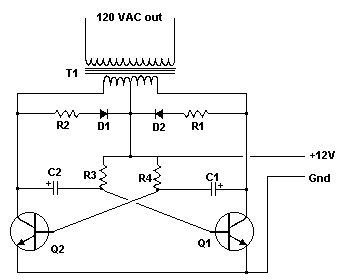
12V to 120V Inverter circuit


Parts

Part
Total Qty.
Description
Substitutions
C1, C2268 uf, 25 V Tantalum Capacitor
R1, R2210 Ohm, 5 Watt Resistor
R3, R42180 Ohm, 1 Watt Resistor
D1, D22HEP 154 Silicon Diode
Q1, Q222N3055 NPN Transistor (see "Notes")
T1124V, Center Tapped Transformer (see "Notes")
MISC1Wire, Case, Receptical (For Output)


Notes

  1. Q1 and Q2, as well as T1, determine how much wattage the inverter can supply. With Q1,Q2=2N3055 and T1= 15 A, the inverter can supply about 300 watts. Larger transformers and more powerful transistors can be substituted for T1, Q1 and Q2 for more power.
  2. The easiest and least expensive way to get a large T1 is to re-wind an old microwave transformer. These transformers are rated at about 1KW and are perfect. Go to a local TV repair shop and dig through the dumpster until you get the largest microwave you can find. The bigger the microwave the bigger transformer. Remove the transformer, being careful not to touch the large high voltage capacitor that might still be charged. If you want, you can test the transformer, but they are usually still good. Now, remove the old 2000 V secondary, being careful not to damage the primary. Leave the primary in tact. Now, wind on 12 turns of wire, twist a loop (center tap), and wind on 12 more turns. The guage of the wire will depend on how much current you plan to have the transformer supply. Enamel covered magnet wire works great for this. Now secure the windings with tape. Thats all there is to it. Remember to use high current transistors for Q1 and Q2. The 2N3055's in the parts list can only handle 15 amps each.
  3. Remember, when operating at high wattages, this circuit draws huge amounts of current. Don't let your battery go dead :-).
  4. Since this project produces 120 VAC, you must include a fuse and build the project in a case.
  5. You must use tantalum capacitors for C1 and C2. Regular electrolytics will overheat and explode. And yes, 68uF is the correct value. There are no substitutions.
  6. This circuit can be tricky to get going. Differences in transformers, transistors, parts substitutions or anything else not on this page may cause it to not function.
  7. If you want to make 220/240 VAC instead of 120 VAC, you need a transformer with a 220/240 primary (used as the secondary in this circuit as the transformer is backwards) instead of the 120V unit specified here. The rest of the circuit stays the same. But it takes twice the current at 12V to produce 240V as it does 120V.
source: aaroncake.net

Advertisement