Showing posts with label Transistor. Show all posts

80 milliwatt 3 Transistor Audio Amp Circuit Schematic with explanation

This circuit is similar to the one above but uses positive feedback to get a little more amplitude to the speaker. I copied it from a small 5 transistor radio that uses a 25 ohm speaker. In the circuit above, the load resistor for the driver transistor is tied directly to the + supply. This has a disadvantage in that as the output moves positive, the drop across the 470 ohm resistor decreases which reduces the base current to the top NPN transistor. Thus the output cannot move all the way to the + supply because there wouldn't be any voltage across the 470 resistor and no base current to the NPN transistor. 

3 Transistor Audio Amp Circuit Diagram: 


80 milliwatt 3 Transistor Audio Amp Circuit Schematic with explanation


This circuit corrects the problem somewhat and allows a larger voltage swing and probably more output power, but I don't know how much without doing a lot of testing. The output still won't move more than a couple volts using small transistors since the peak current won't be more than 100mA or so into a 25 ohm load. But it's an improvement over the other circuit above.  In this circuit, the 1K load resistor is tied to the speaker so that as the output moves negative, the voltage on the 1K resistor is reduced, which aids in turning off the top NPN transistor.

When the output moves positive, the charge on the 470uF capacitor aids in turning on the top NPN transistor. The original circuit in the radio used a 300 ohm resistor where the 2 diodes are shown but I changed the resistor to 2 diodes so the amp would operate on lower voltages with less distortion. The transistors shown 2n3053 and 2n2905 are just parts I used for the other circuit above and could be smaller types. Most any small transistors can be used, but they should be capable of 100mA or more current. A 2N3904 or 2N3906 are probably a little small, but would work at low volume.

The 2 diodes generate a fairly constant bias voltage as the battery drains and reduces crossover distortion. But you should take care to insure the idle current is around 10 to 20 milliamps with no signal and the output transistors do not get hot under load.  The circuit should work with a regular 8 ohm speaker, but the output power may be somewhat less. To optimize the operation, select a resistor where the 100K is shown to set the output voltage at 1/2 the supply voltage (4.5 volts). This resistor might be anything from 50K to 700K depending on the gain of the transistor used where the 3904 is shown.

“two polarities” Bipolar transistors

Bipolar transistors simultaneously use holes and electrons to conduct, hence their name (from “two polarities”). Like FETs, bipolar transistors contain p- and n-type materials configured in input, middle, and output regions. In bipolar transistors, however, these regions are referred to as the emitter, the base, and the collector. Instead of relying, as FETs do, on a secondary voltage source to change the polarity beneath the gate (the field effect), bipolar transistors use a secondary voltage source to provide enough energy for electrons to punch through the reverse-biased base-collector junction (see figure)
“two polarities” Bipolar transistors
As the electrons are energized, they jump into the collector and complete the circuit. Note that even with highly energetic electrons, the middle section of p-type material must be extremely thin for the electrons to pass through both junctions.

A bipolar base region can be fabricated that is much smaller than any CMOS transistor gate. This smaller size enables bipolar transistors to operate much faster than CMOS transistors. Bipolar transistors are typically used in applications where speed is very important, such as in radio-frequency ICs. On the other hand, although bipolar transistors are faster, FETs use less current. The type of switch a designer selects depends on which benefits are more important for the application: speed or power savings. This is one of many trade-off decisions engineers make in designing their circuits.


programmable unijunction transistor (PUT) controlled sawtooth generator circuit

programmable unijunction transistor (PUT) controlled sawtooth generator circuit


A PUT controlled sawtooth generator circuit is shown in figure. When power is first applied, the programmable unijunction transistor (PUT) is off. The capacitor C begins to charge up and the output voltage rises. This continues until the output voltage (which is also the PUT anode voltage) is about 0.7 V above the control input (the gate voltage). The PUT gets switched on. The capacitor C is shorted out through PUT and, therefore, capacitor gets immediately dis­charged through the PUT. The output voltage, which is equal to the voltage across the capacitor, falls. When the current through the PUT falls below its holding current IH, it goes off and the cycle repeats. When the PUT turns off, approximately 1 V is usually left on the capacitor. The output waveform is shown in figure.

programmable unijunction transistor (PUT) controlled sawtooth generator circuit

The time period of the PUT controlled sawtooth generator depends on the charge rate (V/RC) and the control voltage Vcontrol. This is obvious from figure.

Time period, T = Distance / Rate = (Vcontrol + 0.7 V) – 1V / (І-V І/RC)

= Vcontrol RC / І-V І………………. {І-V І = magnitude of –V}

and frequency, f = 1/T = І-V І/Vcontrol RC

The PUT controlled sawtooth generator can be used as a voltage-to-frequency converter.

Precautions

  • The cathode of the PUT must be tied to ground or virtual ground and current flows only from anode to cathode. So PUT cannot be used to control a negative ramp generator.
  • To turn-off the current through the PUT must drop below its holding current IH (specified by the manufacturer). When the PUT is on, a current equal to that used to charge the capacitor, in addition to capacitor discharge current, flows through the PUT. This current flows through R to V- must be below IH.

That is, I = V/R < IH

Failing which, once the PUT goes on, it will be held on by this charge current, even when the capacitor has fully discharged. This charge current can be lowered by increasing R or reducing negative voltage V-.. However, both of these factors affect the change rate and. Therefore, the frequency. For keeping frequency unaffected the changes in either R or V- will have to be balanced with appropriate changes in C.


power transistor based megaphone circuit

Just about any power transistor can be used in this megaphone.Its suitable for boats,playing fields etc.the transistors Q1 & Q2 are the HEP-230 type which are easily available in the market.The transistors are parallely connected to handle the required power and speaker matching.The microphone is a carbon type like that used in telephone hand sets.If a regular carbon mike is used the push-to-talk (PTT) switch can be connected in place of S1 to provide PTT operation.There will be no warm up or “capacitor charge time.
power transistor based megaphone circuit
  • The circuit can be powered from a 12V battery or 12V DC power supply.
  • The POT R1 can be adjusted to obtain maximum volume with minimum distortion.
  • It will be always better to mount the transistors on heat sink.
S:circuitstoday.blogspot.com

Introduction to IGBT-Insulated Gate Bipolar Transistors

Introduction to IGBT-Insulated Gate Bipolar Transistors

Introduction to IGBT-Insulated Gate Bipolar Transistors


Insulated gate bipolar transistor (IGBT) is a new high conductance MOS gate-controlled power switch. The fabrication process is similar to that of an N-channel power MOSFET but employs an N-epitaxial layer grown on a P+ substrate. In operation the epitaxial region is conductivity modulated (by excess holes and electrons) thereby eliminating a major component of the on-resistance. For example, on-resistance values have been reduced by a factor of about 10 compared with those of conventional N-channel power MOSFET of comparable size and voltage capability.

Vertical MOSFETs have become increasing important in discrete power device applications due primarily to their high input impedance, rapid switching times, and low resistance. However, the on-resistance of such devices increases with increasing drain-source voltage capability, thereby limiting the practical value of power MOSFETs to applications below a few hundred volts. Here we will describe the fabrication and characteristics of a new vertical power MOSFET structure that provides an on-resistance value about one-tenth of that of conventional power MOSFETs of the same size and voltage capability. In this semiconductor device, the conductivity of the epitaxial drain region of a conventional MOSFET is dramatically increased (modulated) by injected carriers, this mechanism results in a significant reduction in the device on-resistance and leads to the acronym IGBTs.

This device, while similar in structure to the MOS-gated thyristor, is different in a fundamental way; it maintains gate control (does not latch) over a wide range of anode current and voltage. The structure and the equivalent circuit of the IGBT and IGBT schematics is shown in figures respectively. They are similar to those of an MOS-gated thyristor, except for the presence of the shunting resistance RG in each unit cell. The fabrication is like that of a standard N-channel power MOSFET except that the N~ epitaxial silicon layer is grown on a P+ substrate instead of an N+ substrate. The heavily doped P+ region in the center of each unit cell, combined with the sintered aluminium contact shorting the N+ and P+ regions, provides the shunting resistance RS shown in IGBT schematics figure.This has the effect of lowering the current gain of the N-P-N transistor (αN-P-N) so that αN-P-N + αP-N-P < 1- Thus latching is avoided and gate control is maintained within a large operating range of anode voltage and current.

S:circuitstoday.com

Construction and operation of a UJT


Construction and operation of a UJT

Unijunction transistor (abbreviated as UJT), also called the double-base diode is a 2-layer, 3-terminal solid-state (silicon) switching device. The device has-a unique characteristic that when it is triggered, its emitter current increases re generatively (due to negative resistance characteristic) until it is restricted by emitter power supply. The low cost per unit, combined with its unique characteristic, have warranted its use in a wide variety of applications. A few include oscillators, pulse generators, saw-tooth generators, triggering circuits, phase control, timing circuits, and voltage-or current-regulated supplies. The device is in general, a low-power-absorbing device under normal operating conditions and provides tremendous aid in the continual effort to design relatively efficient systems!

Construction of a UJT

The basic structure of a unijunction transistor is shown in figure. It essentially consists of a lightly-doped N-type silicon bar with a small piece of heavily doped P-type material alloyed to its one side to produce single P-N junction. The single P-N junction accounts for the terminology unijunction. The silicon bar, at its ends, has two ohmic contacts designated as base-1 (B1) and base-2 (B2), as shown and the P-type region is termed the emitter (E). The emitter junction is usually located closer to base-2 (B2) than base-1 (B1) so that the device is not symmetrical, because symmetrical unit does not provide optimum electrical characteristics for most of the applications.

The symbol for unijunction transistor is shown in figure. The emitter leg is drawn at an angle to the vertical line representing the N-type material slab and the arrowhead points in the direction of conventional current when the device is forward-biased, active or in the conducting state. The basic arrangement for the UJT is shown in figure.

A complementary UJT is formed by diffusing an N-type emitter terminal on a P-type base. Except for the polarities of voltage and current, the characteristics of a complementary UJT are exactly the same as those of a conventional UJT.

The worth noting points about UJT are given below:

  • The device has only one junction, so it is called the unijunction device.
  • The device, because of one P-N junction, is quite similar to a diode but it differs from an ordinary diode as it has three terminals.
  • The structure of a UJT is quite similar to that of an N-channel JFET. The main difference is that P-type (gate) material surrounds the N-type (channel) material in case of JFET and the gate surface of the JFET is much larger than emitter junction of UJT.
  • In a unijunction transistor the emitter is heavily doped while the N-region is lightly doped, so the resistance between the base terminals is relatively high, typically 4 to 10 kilo Ohm when the emitter is open.
  • The N-type silicon bar has a high resistance and the resistance between emitter and base-1 is larger than that between emitter and base-2. It is because emitter is closer to base-2 than base-1.
  • UJT is operated with emitter junction forward- biased while the JFET is normally operated with the gate junction reverse-biased.
  • UJT does not have ability to amplify but it has the ability to control a large ac power with a small signal. It exhibits a negative resistance characteristic and so it can be employed as an oscillator.
Construction and operation of a UJT


Operation of a UJT

Imagine that the emitter supply voltage is turned down to zero. Then the intrinsic stand-off voltage reverse-biases the emitter diode, as mentioned above. If VB is the barrier voltage of the emitter diode, then the total reverse bias voltage is VA + VB = Ƞ VBB + VB. For silicon VB = 0.7 V.

Now let the emitter supply voltage VE be slowly increased. When VE becomes equal to Ƞ VBB, IEo will be reduced to zero. With equal voltage levels on each side of the diode, neither reverse nor forward current will flow. When emitter supply voltage is further increased, the diode becomes forward-biased as soon as it exceeds the total reverse bias voltage (Ƞ VBB + VB). This value of emitter voltage VE is called the peak-point voltage and is denoted by VP. When VE = VP, emitter current IE starts to flow through RB1 to ground, that is B1. This is the minimum current that is required to trigger the UJT. This is called the peak-point emitter current and denoted by IP. Ip is inversely proportional to the interbase voltage, VBB. Now when the emitter diode starts conducting, charge carriers are injected into the RB region of the bar. Since the resistance of a semiconductor material depends upon doping, the resistance of region RB decreases rapidly due to additional charge carriers (holes). With this decrease in resistance, the voltage drop across RB also decrease, cause the emitter diode to be more heavily forward biased. This, in turn, results in larger forward current, and consequently more charge carriers are injected causing still further reduction in the resistance of the RB region. Thus the emitter current goes on increasing until it is limited by the emitter power supply. Since VA decreases with the increase in emitter current, the UJT is said to have negative resistance characteristic. It is seen that the base-2 (B2) is used only for applying external voltage VBB across it. Terminals E and B1 are the active terminals. UJT is usually triggered into conduction by applying a suitable positive pulse to the emitter. It can be turned off by applying a negative trigger pulse.

S:circuitstoday.com

uni junction transisitor (UJT) featurese

uni junction transisitor (UJT) featurese

The static emitter char­acteristic (a curve showing the relation between emitter voltage VE and emitter current IE) of a UJT at a given inter base voltage VBB is shown in figure. From figure it is noted that for emitter potentials to the left of peak point, emitter current IE never exceeds IEo . The current IEo corresponds very closely to the reverse leakage current ICo of the conventional BJT. This region, as shown in the figure, is called the cut-off region. Once con­duction is established at VE = VP the emitter po­tential VE starts decreasing with the increase in emitter current IE. This Corresponds exactly with the decrease in resistance RB for increasing cur­rent IE. This device, therefore, has a negative resistance region which is stable enough to be used with a great deal of reliability in the areas of applications listed earlier. Eventually, the valley point reaches, and any further increase in emitter current IE places the device in the saturation region, as shown in the figure. Three other important parameters for the UJT are IP, VV and IV and are defined below:

Peak-Point Emitter Current. Ip. It is the emitter current at the peak point. It repre­sents the rnimrnum current that is required to trigger the device (UJT). It is inversely proportional to the interbase voltage VBB.

Valley Point Voltage VV The valley point voltage is the emitter voltage at the valley point. The valley voltage increases with the increase in interbase voltage VBB.

Valley Point Current IV The valley point current is the emitter current at the valley point. It increases with the increase in inter-base voltage VBB.

Special Features of UJT. The special features of a UJT are :

  1. A stable triggering voltage (VP)— a fixed fraction of applied inter base voltage VBB.
  2. A very low value of triggering current.
  3. A high pulse current capability.
  4. A negative resistance characteristic.
  5. Low cost.

Basic transistor clipping circuit working

The transistor has two types of linearities —One linearity happens when the transistor passes from cut-in region to the active region. The other linearity occurs when the transistor passes from the active region to the saturation region. When any input signal passes through the transistor, across the boundary between cut-in region and active region, or across the boundary between the active region and saturation region, a portion of the input signal waveform will be clipped off. Portion of the input waveform which keeps the transistor in the active region shall appear at the output without any distortion. In such a case, it is the input current rather than the input voltage that should have the waveform of the signal of interest. Obvious reason is that over a large signal excursion in the active region, the tran­sistor output current responds linearly to the input current but is related quite non-linearly to the input voltage. There­fore, a current drive is used in a transistor clipper, as illus­trated in the figure given below.

Basic transistor clipping circuit working

In the active region, the value of the resistor RB must be large enough when compared to the input resistance of the transistor. The input base current will have the waveform of input voltage and

iB = vin – base-to-emitter cut-in voltage / RB

Waveforms for the transistor clipper for ramp input are shown in the figure given below.

Basic transistor clipping circuit working

The voltages are considered for a germanium transistor. The transistor will be working in the cut-off region at -0.1 V. When the voltage reaches 0.1 V, the transistor t starts conducting and will switch to the active region. When the voltage increases to 0.3 V, the transistor switches to the saturation region and the base-emitter voltage VBE is limited to 0.3 V. As the transistor switches from the cut-off region to active region and then into saturation, the input base current iB increases slowly. In the graph, the output current (collector current, Ic) will be of the same form as the input base current., when the transistor works in the active region. In saturation region, however collector current will become constant and becomes Ic(sat).

Waveforms for the transistor clipper for sinusoidal input are shown in the figure below.

Basic transistor clipping circuit working
S:circuitstoday.com

flash duration and brightness is much enhanced by using a 1.2-volt single transistor flyback (Joule Thief) circuit

This is a 1.2-volt single transistor flyback (Joule Thief) circuit that features a third coil. With it, flash duration and brightness is much enhanced, even with just a 10uF capacitor, as can be seen in the following schematic.

The parts to the right of T1 form a simple Joule-thief (‘Blocking’ oscillator) circuit which boosts the 1.2v supply to 3.5v to operate the LED. C1 is used to extend the charge and discharge cycles to increase brightness and efficiency. Components R, C and D1 form a simple timing circuit which, with the values shown, is about 1 sec per flash. Capacitor C charges up through resistor R until its voltage is enough to bias D1 and turn Q1 on to light up the LED. The charge on C is slowly drained, until it is no longer able to keep Q1 on, at which point the LED turns off until C can be recharged by R again. More information on this circuit and others can be found at

flash duration and brightness is much enhanced by using a 1.2-volt single transistor flyback (Joule Thief) circuit

S: http://quantsuff.com.

transistors based analog flip flop electronic suite

This is Analog Flip Flop Electronic Suite which built based on 2 transistors work as switch. This is very easy made and very cheap circuit. You can use this circuit as “the first project” for your students.

Replace the Resistor 10K with variable resistor 20K or replace the electrolytic capacitor 100uF with other value for change the frequency of LED’s flash.

transistors based analog flip flop electronic suite

2N2222 NPN based VCR Camera Video Detector Switch Controller Circuit


This video detector switch controller circuit uses the video output from a VCR or camera to control a relay.

PARTS LIST
R110KΩ
R210KΩ
R31KΩ
R433KΩ
C11µF 16V
C2100µF 16V
D11N4148
D21N4148
D31N4001
Q1, Q2, Q32N2222
RL112V or 9V Relay

A1 = To video output

A2 = To circuit under control

Video turns on Q1, cutting off Q2, allowing Q3 to be forward biased, activating relay RL1.


You can use the timer in your VCR and this unit to generate long time delays as well.


transistor Q1 based simple intercom


Very simple and useful circuit for communication between two people. The transistor Q1 is used to amplify the weak output signal of the speaker when someone pushes their side push-button to speak. The configuration of Q1 pre-amplifier is formed as so-called common-base, because of matching low impedance of speaker with the input impedance of the pre-amplifier, so that it can produce maximum gain. To drive the speaker, the circuit uses an integrated audio power amplifier LM380. The whole circuit can be built on a vero-board for simplicity and still get good result! However, if you intend to design a PCB for this circuit, you would probably get better result. Please note that, the PCB should be designed for the master side, and it should connect to the slave side via shield stereo cable.

S:newcircuits.com


Electronic Semiconductor Device UJT(Uni Junction Transistor)Tests

Introduction to UJT:

A Uni Junction Transistor (UJT) is an electronic semiconductor device. It is made of a lightly doped (high resistance) silicon bar, which can either be an n-type or p- type. It is a three terminal device with characteristics very different from the conventional 2 junction, bipolar transistor. It is a pulse generator with the trigger or control signal applied at the emitter.

There are two types of Uni Junction Transistors:-

1. The original Uni Junction Transistor (UJT), is a simple device that is essentially a bar of N type semiconductor material into which P type material has been diffused somewhere along its length.

2. The Programmable Uni Junction Transistor (PUT), is a close cousin to the Thyristor. Like the Thyristor, it consists of four P-N layers and has an Anode and a Cathode connected to the first and the last layer, and a Gate connected to one of the inner layers. They are not directly interchangeable with conventional UJTs but perform a similar function.

For both types, their main use is as a trigger device for thyristors and as the active device in relaxation oscillators. The graph of emitter voltage against emitter current of a Uni Junction Transistor shows an area of negative resistance; this is what makes it very useful.

Tests:-

Test #1:-

1. Set a Digital Multimeter in the Ohms position.
2. Read the resistance between Base 1 and Base 2.
3. Read the resistance between Base 2 and Base 1 (reversing the leads).

Both of the readings should approximately be equal (high resistance).

Test #2:-

1. Connect the negative lead to the Emitter.
2. Measure the resistance from Emitter to Base 1 using the positive lead.
3. Measure the resistance from Emitter to Base 2 using the positive lead.

Both of the readings should approximately be equal (high resistance).

Test #3:-

1. Connect the positive lead to the Emitter.
2. Measure the resistance from Emitter to Base 1 using the negative lead.
3. Measure the resistance from Emitter to Base 2 using the negative lead.

Both of the readings should approximately be equal (low resistance).

S:www.circuithut.com

Simple Microphone Preamplifier Using 2 Transistor

This is a simple microphone preamplifier circuit which you can use between your microphone and stereo amplifier. This circuit amplifier microphone suitable for use with normal home stereo amplifier line/CD/aux/tape inputs.
Skema Rangkaian Simple Microphone Preamplifier

The circuit is based on a low noise, high gain 2 stage PNP and NPN transistor amplifier, using DC negative feedback through R6 to stabilize the working conditions quite precisely. Output level is attenuated by P1 but, at the same time, the stage gain is lowered due to the increased value of R5. This unusual connection of P1, helps in obtaining a high headroom input, allowing to cope with a wide range of input sources (0.2 to 200mV RMS for 1V RMS output).

List Component of Microphone Preamplifier Circuit
P1         : 2K2 Potentiometer R1,R2,R3   : 100K R4         : 8K2 R5         : 68R R6         : 6K8 R7,R8      : 1K R9         : 150R C1         : 1µF/63V C2,C3,C4   : 100µF/25V C5         : 22µF/25V Q1         : BC560C Q2         : BC550C  

advance guitar effect(Fat Cat distortion pedal )

Rangkaian Guitar Effect - Fat Cat Distortion Pedal


circuit of Fat Cat Distortion pedal Distortion is good for blues, rock, pop and alternative. by using this circuit You can hear the fat tone, even at maximum overdrive.

The transistor 2SC1815/BC546 is configured as voltage follower, giving a high impedance for the input. The op-amp serve an adjustable gain amplifier, to boost the signal until it reach the forward bias voltage (about 0.7 volts) of 1N4148 diodes, where the signal is clipped.

rangkaian fat cat distortion pedal Skema Rangkaian Fat Cat Distortion Pedal for guitar

The tone controller in use adding a high frequency attenuation when the resistance is set to higher values. Finally, 2SK188/BF245 field effect transistors (FET) is used to buffer the tone control circuit to give low output impedance. Without this buffer, the tone controller would also act like a volume control when the output is connected to a low impedance input.

Quick data IC OP-Amp 5534

The NE5534, NE5534A, SE5534, and SE5534A are monolithic high-performance operational amplifiers combining excellent dc and ac characteristics. Some of the features include very low noise, high output drive capability, high unitygain and maximum-output-swing bandwidths, low distortion, and high slew rate.

IC OP-Amp 5534 Pin

absolute maximum ratings
  • Supply voltage, VCC+ . . . . . . . . . . . . . . . . . . . . . . . 22 V
  • Supply voltage, VCC– . . . . . . . . . . . . . . . . . . . . . . . – 22 V
  • Input voltage either input . . . . . . . . . . . . . . . . . . . VCC+
  • Input current . . . . . . . . . .. . . . . . . . . . . . . . . . . . . . . ±10 mA
  • Duration of output short circuit . . . . . . . . . . . . . . . unlimited
  • Operating free-air temperature range . . . . . . . . . 0°C to 70°C
  • Storage temperature range . . . . . . . . . . . . . . . . . . – 65°C to 150°C
  • Case temperature for 60 seconds. . . .. . . . . . . . . . 260°C
  • Lead temperature range 1,6 mm (1/16 inch) from case for 60 seconds: JG package . . . . .. 300°C
  • Lead temperature range 1,6 mm (1/16 inch) from case for 10 seconds: D or P package . . . 260°C
  • S:elektroarera.blogspot.com

output amplified by the transistor 2N2222 for sound effect generator

This is a very simple. The IC UM3561 produces four differen sound effects, the output at Pin 3 being amplified by the transistor 2N2222. A 64 ohm loudspeaker can be substituted in place of the 56 ohm resistor and 8 ohm loudspeaker.

Sound Effects Generator circuitSkema Rangkaian Sound Effects Generator

The 2 pole 4 way switch controls the sound effects. Position 1 (as drawn) being a Police siren, position 2 is a fire engine sound, 3 is an ambulance and position 4 is a machine gun effect.

Note:
The IC sound generator UM3561 is now available in a kt from Maplin Electronics.

key hole finder in darkness

This 3 volt Lithium cell operated LED flasher can be used as a key hole finder in darkness. A small lithium button cell can power the circuit more than 6 months continuously with day and night flashes. The circuit can also be used in key stand to search key in darkness.

The circuit is a simple oscillator comprising two complementary transistors BC 547 and BC557. These NPN and PNP transistors are wired as a simple oscillator with components C1 and R1 so that the LED flashes based on the charging and discharging of C1. Current consumption of LED is very low so that a normal 3 volt lithium battery can power the circuit for long time. A miniature 12 volt battery used in Car remote can power the circuit more than 2 years continuously.

Use a high bright transparent 5 mm Yellow LED and fix the unit near the keyhole.


listen your heartbeat using Electronic Stethoscope


Electronic Stethoscope Circuit diagram

An electronic stethoscope is used to listen to your heartbeat and you would normally use a listening tube or stethoscope. This electronic stethoscope circuit uses a piezo sounder from a musical greetings card or melody generator, as a microphone. This transducer has an output signal in the order of 100 mV and its low frequency response is governed by the input impedance of the amplifier.

For this reason we have chosen to use an emitter follower transistor amplifier. This has a high input impedance and ensures that the transducer will have a very low frequency response. At the output you just need to connect a set of low impedance headphones to be able to listen to your heartbeat.

Replacing the emitter follower with a Darlington transistor configuration will further increase the input impedance of the amplifier.

S:electroschematics.com


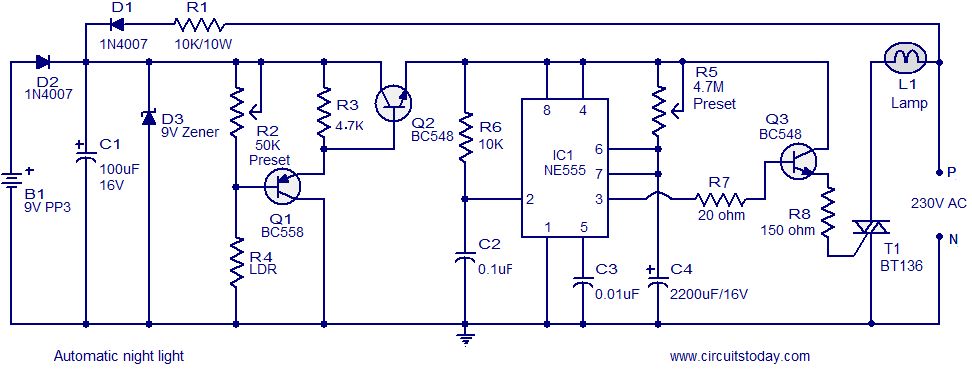
Few transistors and NE555 For Automatic night light


Explanation:
A cheap and simple automatic night light using few transistors and NE555 timer is shown here. The circuit will automatically switch on the AC lamp when night falls and the lamp will be automatically switched off after a preset time.The working of this night light circuit very simple. An LDR is used as the sensor here. At day time the resistance of the LDR will be low and so do the voltage drop across it, the transistor Q1 will be in the conducting mode. When darkness falls the resistance of LDR increases and so do the voltage across it. This makes the transistor Q1 OFF. Base of Q2 is connected to the emitter of Q1 and so Q2 is biased on which in turn powers the IC1. NE555 is wired as monostable multivibrator that is automatically triggered at power ON. This automatic triggering is achieved with the help of capacitor C2. The output of IC1 remains high for a time determined by resistor R5 and capacitor C4. When output of IC1 goes high transistor Q3 is switched ON which triggers triac T1 and the lamp glows. A 9V battery is included in the circuit in order to power the timer circuit during power failures. Resistor R1, diode D1, capacitor C1 and Zener D3 forms the power supply section of the circuit. R7 and R8 are current limiting resistors.

Important to know:

  • The circuit can be assembled on a vero board.
  • Preset R2 can be used to adjust the sensitivity of the circuit.
  • Preset R5 can be used to adjust the ON time of the lamp.
  • With R5 @ 47M the ON time will be around three hours.
  • The wattage of L1 must not exceed 200W.
  • Heat sink is recommended for BT136.
  • IC1 must be mounted on a holder.


Transistor Schmitt Trigger Oscillator


The Schmitt Trigger oscillator below employs 3 transistors, 6 resistors and a capacitor to generate a square waveform. Pulse waveforms can be generated with an additional diode and resistor (R6). Q1 and Q2 are connected with a common emitter resistor (R1) so that the conduction of one transistor causes the other to turn off. Q3 is controlled by Q2 and provides the squarewave output from the collector.


In operation, the timing capacitor charges and discharges through the feedback resistor (Rf) toward the output voltage. When the capacitor voltage rises above the base voltage at Q2, Q1 begins to conduct, causing Q2 and Q3 to turn off, and the output voltage to fall to 0. This in turn produces a lower voltage at the base of Q2 and causes the capacitor to begin discharging toward 0. When the capacitor voltages falls below the base voltage at Q2, Q1 will turn off causing Q2 and Q3 to turn on and the output to rise to near the supply voltage and the capacitor to begin charging and repeating the cycle. The switching levels are established by R2,R4 and R5. When the output is high, the voltage at the base of Q2 is determined by R4 in parallel with R5 and the combination in series with R2. When the output is low, the base voltage is set by R4 in parallel with R2 and the combination in series with R5. This assumes R3 is a small value compared to R2. The switching levels will be about 1/3 and 2/3 of the supply voltage if the three resistors are equal (R2,R4,R5).

There are many different combinations of resistor values that can be used. R3 should low enough to pull the output signal down as far as needed when the circuit is connected to a load. So if the load draws 1mA and the low voltage needed is 0.5 volts, R3 would be 0.5/.001 = 500 ohms (510 standard). When the output is high, Q3 will supply current to the load and also current through R3. If 10 mA is needed for the load and the supply voltage is 12, the transistor current will be 24 mA for R3 plus 10 mA to the load = 34 mA total. Assuming a minimum transistor gain of 20, the collector current for Q2 and base current for Q3 will be 34/20 = 1.7 mA. If the switching levels are 1/3 and 2/3 of the supply (12 volts) then the high level emitter voltage for Q1 and Q2 will be about 7 volts, so the emitter resistor (R1) will be 7/0.0017 = 3.9K standard. A lower value (1 or 2K) would also work and provide a little more base drive to Q3 than needed. The remaining resistors R2, R4, R5 can be about 10 times the value of R1, or something around 39K.

The combination of the capacitor and the feedback resistor (Rf) determines the frequency. If the switching levels are 1/3 and 2/3 of the supply, the half cycle time interval will be about 0.693*Rf*C which is similar to the 555 timer formula. The unit I assembled uses a 56K and 0.1 uF cap for a positive time interval of about 3.5 mS. An additional 22K resistor and diode were used in parallel with the 56K to reduce the negative time interval to about 1 mS.

In the diagram, T1 represents the time at which the capacitor voltage has fallen to the lower trigger potential (4 volts at the base of Q2) and caused Q1 to switch off and Q2 and Q3 to switch on. T2 represents the next event when the capacitor voltage has risen to 8 volts causing Q2 an Q3 to turn off and Q1 to conduct. T3 represents the same condition as T1 where the cycle begins to repeat. Now, if you look close on a scope, you will notice the duty cycle is not exactly 50% This is due to the small base current of Q1 which is supplied by the capacitor. As the capacitor charges, the E/B of Q1 is reverse biased and the base does not draw any current from the capacitor so the charge time is slightly longer than the discharge. This problem can be compensated for with an additional diode and resistor as shown (R6) with the diode turned around the other way.

Source

Advertisement